


Hundreds of protesters yesterday evening ended their 20-hour “occupation” of a government building in Taipei to protest against a land seizure in Miaoli County and land expropriation across the country, but vowed more occupation campaigns if the government failed to listen to their demands.
“As the protest draws to a close now, it is, at the same time, only a beginning. [The protest] serves as a warning to all government agencies, which betrayed their responsibility to the people, that they should be ready for people’s occupation at all times,” said Tsai Pei-hui (蔡培慧), spokesperson for the Taiwan Rural Front, the protest’s main organizer.
While the Ministry of the Interior’s (MOI) response to the protesters’ four demands was unacceptable, Tsai said a prolonged occupation would “fall into the government’s trap” because President Ma Ying-jeou’s (馬英九) administration was trying to wear the protesters out.

Photo: Chien Jung-fong, Taipei Times
The protesters chose to paralyze the operation of the ministry because it was in charge of land management affairs.
They demanded the MOI to apologize, compensate and return the lands to the four households in Dapu Borough (大埔) in Miaoli County’s Jhunan Township (竹南), whose houses were demolished on July 18, despite the government’s pledge to preserve them. They also asked the government to probe potential corruption cases related to land seizures and immediately amend the Land Expropriation Act (土地徵收條例).
Deputy Minister of the Interior Hsiao Chia-chi (蕭家淇) tried to break the deadlock with a meeting with the protesters at 11am yesterday, but failed to make substantial promises as he was whisked off by the crowds, who demanded to meet with Minister of the Interior Lee Hung-yuan (李鴻源).
Lee did not come out to meet with them, but organizers decided to call off the sit-in anyway, with Tsai saying the campaign was a relative success “because no one has ever besieged a government building and paralyzed a ministry before.”
The sit-in, part of the protest titled “818 Tear down the government,” was a follow-up to a night rally on Ketagalan Boulevard in front of the Presidential Office Building on Sunday evening. The rally, which organizers said drew about 20,000 participants, was held to commemorate the one-month anniversary of the demolition of the four houses, torn down to make way for a science park project.
The peaceful rally ended at about 10pm on Sunday, before the protesters caught the police by surprise as hundreds of demonstrators, who initially said they would stage an overnight sit-in in front of the Executive Yuan, executed a successful “ambush,” turning to the nearby Joint Central Government Building (JCGB) complex that also houses some of the legislative rooms.
After a brief confrontation with a thin police line, the crowds entered the complex and occupied both entrances of the South Tower of the JCGB, where they began the overnight sit-in without interruption from the police deployed in and around the building.
The protesters, consisting mostly of young people, raised a protest flag to replace the national flag in front of the building and sprayed slogans on the building walls and the pavement.
The police sent reinforcements yesterday morning, setting up blockades around the South Tower and monitoring pedestrians. Public servants were able to enter the North Tower and reach South Tower through an underground passage.
Supporters who could not make it to the sit-in tried to give the participants a lift by sending water, instant noodles and pizzas to the site.
Commenting on the protest, Legislative Speaker Wang Jin-pyng (王金平) criticized the demonstrators for removing a national flag and replacing it with a protest banner, calling the move “disrespectful, not just to the national flag, but also to the Legislative Yuan.”
The legislature respects the protest and appreciates their demands, but people should still respect the system and authority,” he said.
“What can they change by replacing a flag?” he added.
Additional reporting by CNA

‘NO SECURITY RISK’: The Railway Bureau reassured the public that the technicians’ activities were limited to technical guidance and did not involve sensitive systems The Railway Bureau yesterday said it had invited eight Chinese technicians to assist with an airport MRT construction project. The bureau issued the confirmation after an Internet user said Chinese nationals had entered the construction zone of Taiwan Taoyuan International Airport’s Terminal 3 project. They asked why “individuals from an enemy state” were allowed access to such a major national infrastructure project, which raised serious concerns over Taiwan’s industrial safety, sensitive systems and information security. The bureau’s Northern Region Engineering Branch Office said subcontractor Taiwan Handle Industrial Co (台灣手把工業) of the Taoyuan airport MRT’s “Contract No. CU05 Project A14 Station Civil, MEP &

A US uncrewed surface vessel (USV) encountered multiple Chinese warships during an autonomous transit of the Taiwan Strait, US defense company Seasats said in a statement on Wednesday. Seasats announced that a Lightfish USV had completed the first autonomous transit of the Taiwan Strait. Over five days, the USV traversed the entire length of the Strait while constantly monitoring surface vessel traffic, the company said. The Lightfish encountered multiple Chinese warships, one of which was a Chinese People’s Liberation Army Navy (PLAN) Type 056 corvette, it said. The Chinese vessels were operating “well within Taiwan’s exclusive economic zone without transmitting their identity via the
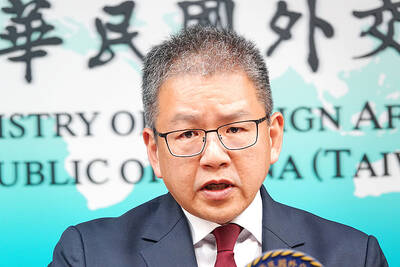
Taiwan is still in the process of assessing the possibility of recruiting workers from Eswatini, the Ministry of Foreign Affairs said yesterday, adding that its goal is to help Eswatini upgrade its vocational training centers. If there are plans to recruit workers from Eswatini, safeguarding national security, protecting public health and ensuring the employment rights of Taiwanese would be prerequisites, Department of West Asian and African Affairs Director-General Yen Chia-liang (顏嘉良) told a news conference. Key considerations would also include filling labor shortages in specific industries, and fostering bilateral professional and technical exchanges, he said. Yen was asked about the progress of labor

‘BOOMING’: ’ The number of partners we have here is incredible. You can see from their stock prices. They’re doing so well, they’re so happy,’ Jensen Huang said Nvidia Corp’s spending in Taiwan has ballooned to about US$150 billion a year, 10 times the US$10 billion to US$15 billion the company spent five years ago, Nvidia chief executive officer Jensen Huang (黃仁勳) said yesterday, suggesting Taiwan’s strategic importance in the global artificial intelligence (AI) supply chain. “Taiwan is the epicenter of the AI revolution. This is where the chips come, packaging comes. This is where the systems are made. This is where AI supercomputers were created,” Huang said at a meeting for the company’s employees in Beitou-Shilin Technology Park (北投士林科技園區) in Taipei, the planned site of Nvidia’s Taipei headquarters. “Taiwan


 RSS
RSS